A leading internet service provider (ISP) in Minas Gerais, offering fiber-optic services and connectivity solutions, with a constant focus on customer experience and field service operation optimization.
Founded in 1998, Valenet is a telecommunications company that offers 100% fiber-optic internet, landline telephony, and pay-TV services for the B2B and B2C markets. The company now has more than 1,000 employees serving over 200,000 customers across more than 120 locations in Minas Gerais, with 17,000 kilometers of access networks.
Valenet stands out for its personalized, humanized service, aiming to delight its customers with high-quality services. The company continuously invests in innovations and exclusive solutions to provide the best connection experience.
In the Minas Gerais telecommunications market, Valenet's main competitors include other companies offering similar internet, telephony, and pay-TV services, such as Vivo, Oi, Claro, and Blink. Valenet differentiates itself through its commitment to quality and customer service, ranking among the state's three largest providers.
“Efficiency, reliability, and responsibility go hand in hand — that's how technology raises the service standard at Valenet.”
Identity
The Project
In 2025, Valenet carried out a structural transformation of its quality monitoring model, which until then had been decentralized, unstandardized, and run by the operational areas themselves. This scenario made it hard to compare results, reduced the effectiveness of evaluations, and limited the evolution of the customer experience.
To address this need, a centralized monitoring area was created, with a standardized methodology, unified evaluation criteria, and structured governance. The new model began using a statistical basis for sampling, calibration processes, mandatory feedback, transparency in evaluations, and direct integration with training and continuous improvement actions.
In addition, Field Service monitoring was transformed, moving from in-person visits to a remote model with digital evidence of service orders, increasing operational efficiency, expanding audit volume, and reducing operational costs.
With the support of the 2clix platform, the initiative consolidated a data-driven, continuous-improvement quality culture, contributing to the evolution of customer experience indicators such as FCR, Contact Rate, CSAT, NPS, and reduced rework across operations.

Diagnosis
Diagnosis
Diagnosis

A model based on in-person audits, generating high travel and technical labor expenses.

Dependence on the customer being home and on favorable weather conditions to evaluate installations.

The need for repeat visits for auditing, causing friction in the relationship with the end customer.

Low predictability of audits and logistical risks inherent to constant team travel.

Project Objective
The project aimed to transform Valenet's monitoring model into a structured, standardized, data-driven process, capable of strengthening service quality and directly contributing to the evolution of the customer experience across all relationship channels.
The initiative sought to create more consistent quality governance, ensuring clear evaluation criteria, greater transparency in monitoring, and a continuous improvement cycle based on feedback, development, and training for service, sales, and Field Service teams.
At the same time, the project also aimed to generate operational efficiency gains, increasing first-contact resolution, reducing rework, and supporting the evolution of the operation's strategic indicators. In this way, monitoring came to act not just as an evaluation process, but as a strategic tool for continuously improving Valenet's customer experience and operational efficiency.
The Solution
Radical resource optimization through the transition to a remote monitoring model.

Ability to evaluate 100% of interactions, eliminating blind spots in field operations.
Using structured data for more precise, agile management decision-making.
Agility and breadth in evaluations without the need to grow the physical team.
Minimizing technical failures and rework through constant, precise monitoring.
The Solution
The Solution

Replacing in-person audits with digital evidence (photos and descriptions), streamlining the process and reducing costs.

Unifying evaluation criteria to ensure consistency and fairness across all analyses performed.
Generating data for individual and collective performance analysis, enabling actionable insights for management.

Implementing a transparent flow for reviewing monitoring results, increasing team trust and engagement.

Continuous monitoring of team development, with a focus on continuous improvement and targeted training.
Transformation
Technicians would visit customers' homes after a service order to verify the procedure. High cost with travel and labor · Low productivity when the customer wasn't home · Strained customer experience · Operational and logistical risk during visits · Low audit predictability · Dependence on weather conditions.
Digital evidence (photos and descriptions) recorded by technicians when closing service orders. Reduced operational costs · Increased monitoring volume · Greater process predictability · More efficiency and scalability in auditing · Reduced operational risks.
The change allowed monitoring to become more efficient, structured, and sustainable for the operation.
Partnership
The 2clix platform was a key element in enabling the transformation of Valenet's monitoring model. The solution made it possible to centralize evaluations, structure quality criteria, and bring more organization to service tracking.
With the tool, it was possible to implement features essential to the new quality management model:
Centralizing all evaluations on a single technology platform.

Creating uniform forms and evaluation criteria for the operation.
Storing feedback for data analysis and continuous improvement.
A transparent, fair process for reviewing monitoring results and feedback.
Continuous tracking of team development and performance.
“2clix's technology acted as an enabler of continuous improvement, supporting Valenet in building an ever-better experience for its customers.”
Results
| Indicator | Target | Starting | Final | Change | Benefits generated |
|---|---|---|---|---|---|
| Monitoring Score | 90 | 34 | 92 | +58 p.p | Standardized criteria and consistent quality growth. |
| % Feedback Applied | 95% | 0% | 99% | +99% | Structuring the agents' development cycle. |
| FCR | 70% | 28% | 42% | +14 p.p | Higher first-contact resolution, reducing rework. |
| No. of Retraining Sessions | N/A | 95 | 195 | +105% | Strengthening team training. |
| NPS | 50 | 16 | 31 | +15 | Improved customer perception and brand relationship. |
| CSAT | 95% | 89% | 91% | +2 p.p | Satisfaction growth from improved service. |
Centralizing monitoring and standardizing the methodology made it possible to turn quality into a structured, data-driven process.
Results
Q1 data reflects the scenario before the project; Q2 reflects the pilot; Q3 and Q4 show results after implementation across the entire service base.
| Indicator | Q1 | Q2 | Q3 | Q4 |
|---|---|---|---|---|
| FCR | 28% | 33% | 39% | 42% |
| NPS | 16 | 21 | 25 | 31 |
| CSAT | 89% | 89% | 90% | 91% |
| Monitoring Score | 75* | 34 | 60 | 92 |
| % Feedback Applied | 0% | 41% | 82% | 99% |
| No. of Retraining Sessions | 95 | 122 | 181 | 195 |
*Unstandardized score before adjusting weights and criteria in the 2clix methodology. Before the project there was no feedback based on monitoring; retraining already existed, but at half the ideal volume.
Results
The partnership between Valenet and 2clix strengthened the quality culture, bringing transparency and efficiency to field service management through structured processes and constant feedback.
Mindset Shift
The transition from an in-person audit model to data-driven remote monitoring was the project's biggest qualitative gain.
Conclusion
We strengthened a quality culture across the entire company and directly contributed to the evolution of our customers' experience.
Unified evaluation criteria and consistent growth in field service quality. Structured processes.

Structuring the agents' development cycle with constant feedback and targeted actions. Professional growth.
Higher first-contact resolution and improved customer perception of the brand. Loyalty and value.

Recognition
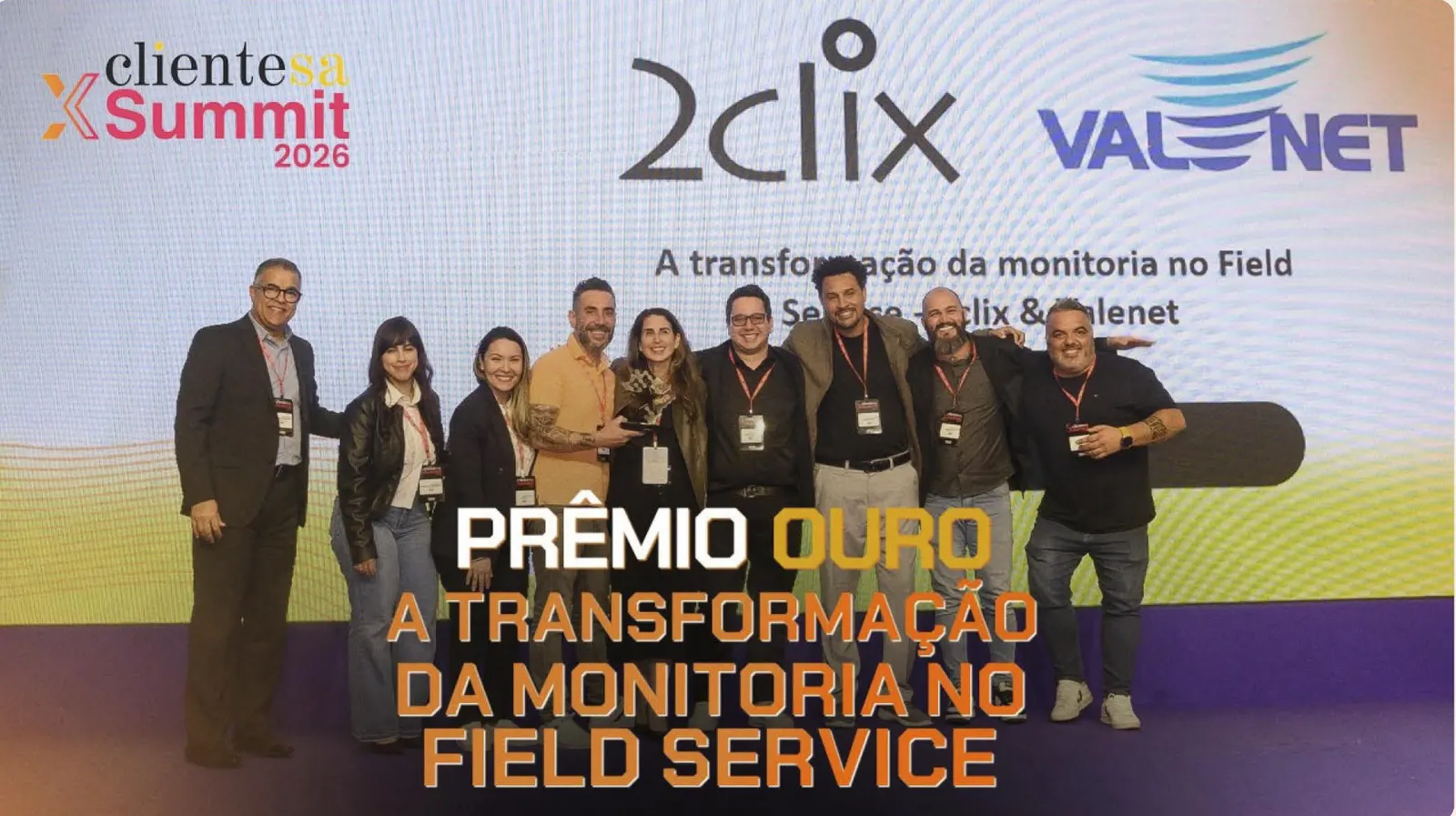
The best innovation projects are born when client and technology evolve together. At ClienteSA X-Summit 2026, 2clix and Valenet won GOLD in the Open Innovation category with the case “The Field Service Monitoring Transformation.”
The recognition highlights an initiative developed to transform quality management in Field Service operations, using artificial intelligence, automation, and data to support decisions, increase operational efficiency, and strengthen the customer experience. More than a quality project, this case shows how innovation applied to the business can generate scale, intelligence, and concrete results for the operation.
Our thanks to Valenet for their trust on this journey, and special recognition to Georgia Mercadante, who played an essential role in making this project a benchmark for innovation. Congratulations to everyone who contributed to this achievement!
“More than optimizing indicators, this case reinforces the view that intelligence and business knowledge, together, turn operations into sustainable performance.”